Bazaar · Entry 09
Rasteh
The trade street: one craft to a run, so the noisy and the smelling sat apart from the fine work, and the whole thing was legible without a sign.
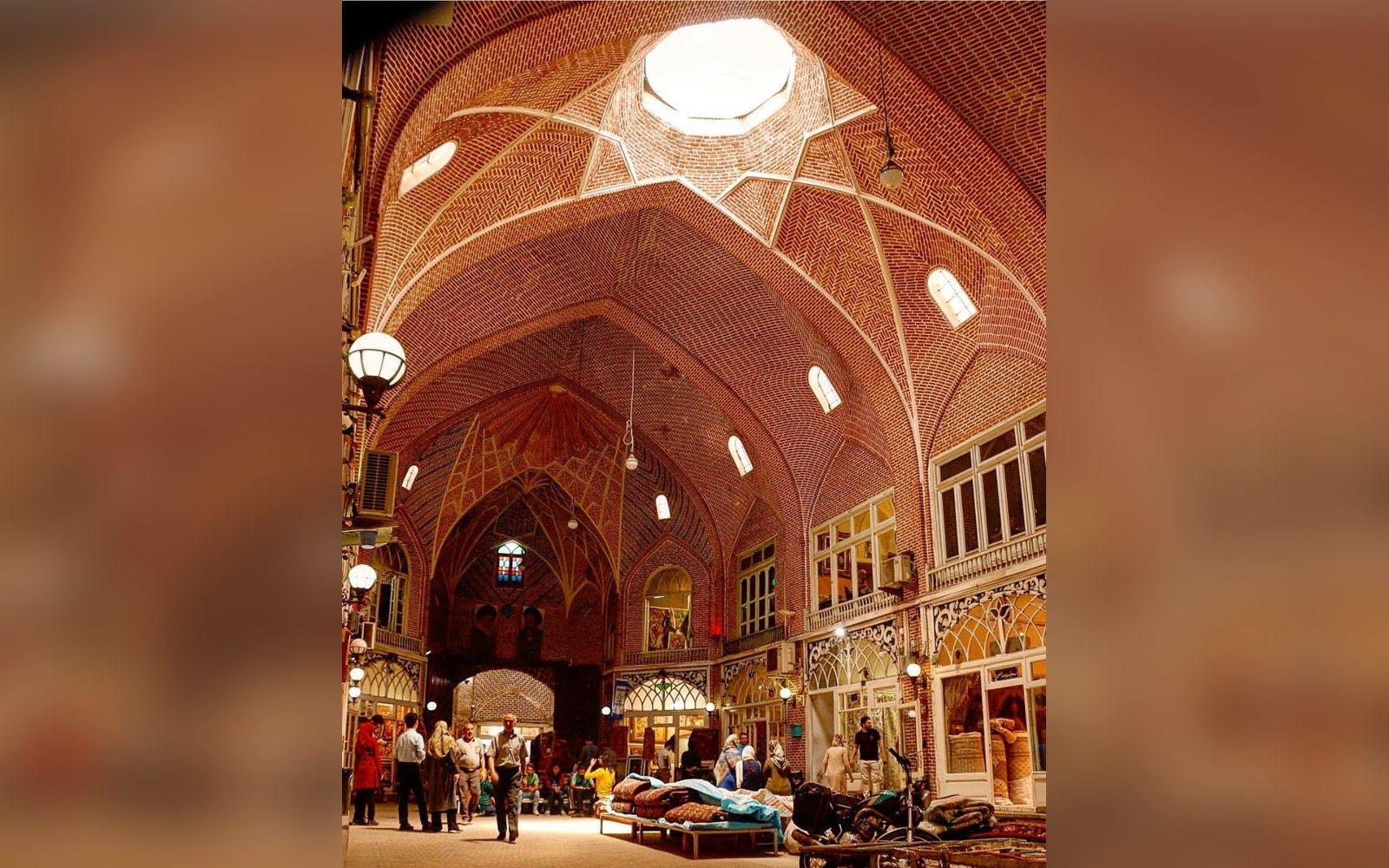
The trade street that sorted itself
A bazaar is not a market in the sense of a field full of stalls. It is a built form: a vaulted corridor, usually narrow enough to touch both walls if you spread your arms, running between two fixed points in the city. That corridor is a rasteh — literally, a straight line — and its most important property is that every unit along it sells the same thing.
The reasons for grouping by trade are practical and several at once.
Copper merchants here, rope-makers there, the dyers further on. The assignment was not accidental and not arbitrary. It followed a logic of proximity, noise, smell and fire risk that made the whole bazaar legible without a single written sign. A buyer who could not read knew exactly where to go. The rasteh was a filing system built in brick.
How the sorting worked
The reasons for grouping by trade are practical and several at once. Noise was one. A coppersmiths' rasteh — the mesian — is genuinely loud: hammers on sheet metal, the ring of a mallet dressing a tray. Placing that work at the bazaar's margin, or along a dedicated run, meant the jewellers and booksellers in a quieter rasteh nearby could transact in peace. Smell was another: the tanners, who worked with lime and organic waste, were pushed to the bazaar's outermost edge, often beyond the main roof. Their rasteh was not so much a street as an outer orbit.
Fire risk shaped things further. Smiths, coppersmiths and chandlers — anyone working an open flame — were kept apart from the textile and paper trades, where a single cinder in the wrong corridor could take out a season's stock. The bazaar was also a warehouse, and the warehousing was specific to what was sold in each rasteh: the storeroom, anbar, behind each unit held stock matching what the frontage sold. Separating the trades kept inventory coherent under a single vaulted roof that covered everything and belonged, in some sense, to everyone.
There was an economic logic to the clustering too. When all the copperware sits in one rasteh, a buyer can move along it comparing price, weight and finish without backtracking. Sellers knew this and accepted it, because the guaranteed foot traffic of a specialist street outweighed the discomfort of direct competition. Prices in a well-run rasteh were remarkably transparent — the grouping that looks like it would depress margins in fact disciplined them.
The higher-value trades sat in the interior: carpets, cloth, jewellery workshops, goldsmiths. These rasteh were closer to the mosque or the caravanserai at the bazaar's centre, which was both the most climatically stable zone and the one with the densest foot traffic from people who had already passed the outer rings of cheaper goods. Position within the bazaar hierarchy was readable from the vault overhead: a wider, higher corridor with better light from its oculi indicated more valuable trade.
The physical form of the rasteh
The structural unit is the bay: a segment of barrel vault, typically carried on thick masonry piers, with a round or octagonal opening at the crown to admit light and vent heat. Shops open directly onto the rasteh, each occupying one or two bays, with a raised dukkan — a platform at sitting height — along the frontage where goods were displayed and negotiations conducted. The merchant sat on the dukkan; the buyer stood or crouched at it. Transactions happened at the threshold, not inside.
The rasteh is dim but not dark. Each oculus throws a shaft of light that travels along the floor as the day moves, and a practised merchant knew the time by where the light fell in his bay. Ventilation followed the same openings — warm air rose and escaped, and the thermal mass of the vault kept the corridor measurably cooler than the street outside. The vaulted roof was not decoration; it was the working envelope of the rasteh's microclimate.
At intervals, the rasteh widened into a small node — a chaharsuq, literally four directions — where another corridor crossed it. These intersections were often domed and slightly more elaborate, marking the seam between one trade zone and the next. The transition from one rasteh to another was readable in the architecture before it was readable in the goods: the vault changed character, the width shifted, and the acoustic signature — the particular blend of voices, hammers and footfall — changed with it.