Tile · Entry 14
Cut Mosaic
Each colour fired separately then cut and set face-down into plaster — slower, sharper, and far more expensive than painting the whole panel.
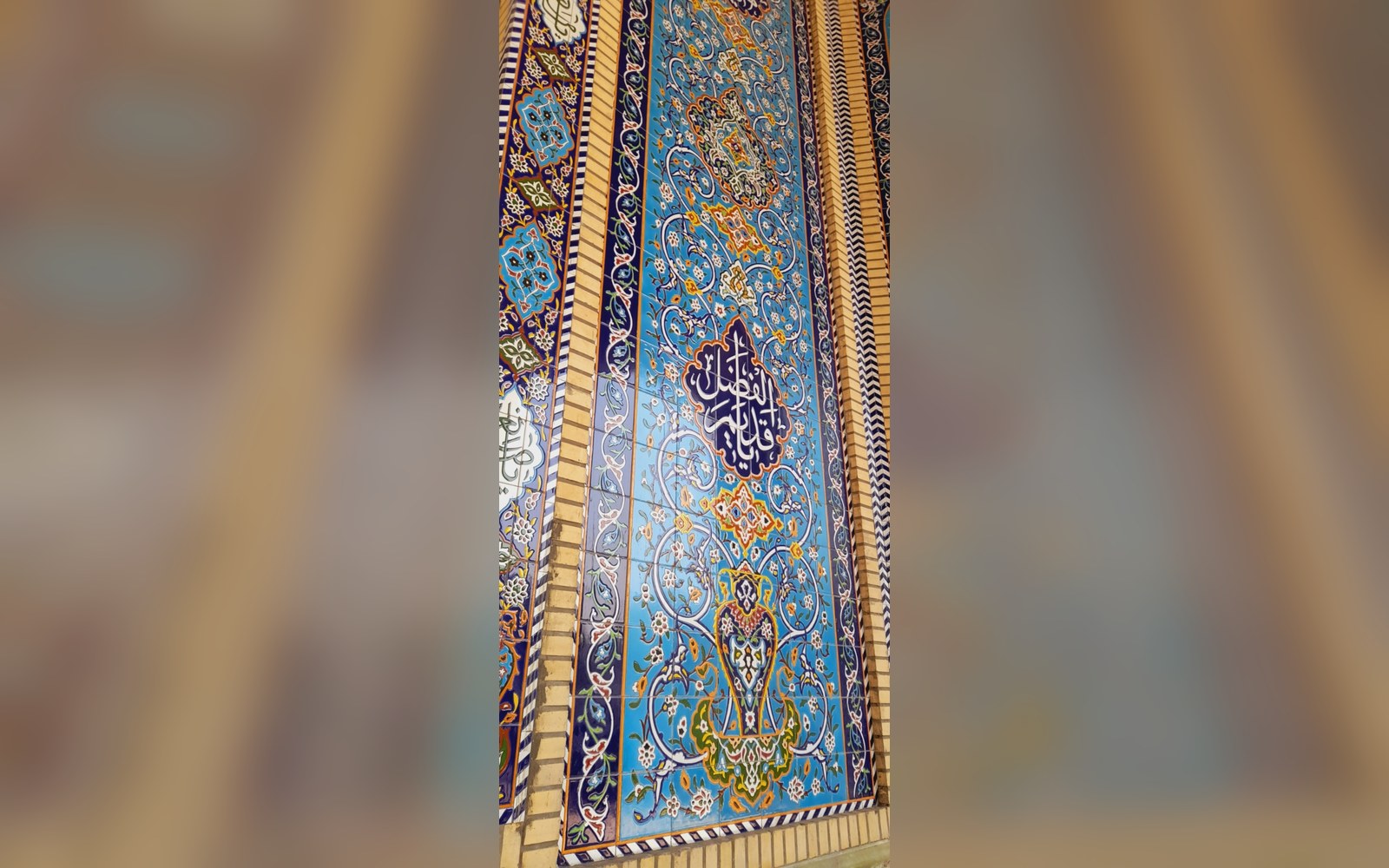
How the colours stay separate
The logic of cut mosaic, known in Persian as kāshi-yi moarrag (mosaic tile), begins with a simple problem: glaze colours run when fired. Painting several colours onto a single tile and putting it in the kiln risks every boundary blurring — red bleeding into blue, turquoise into white. One solution is to draw dark lines between the zones and accept soft edges, which is exactly what the haft rang technique does. The other solution is to fire each colour separately, on its own tile, and then cut the fired pieces to shape and assemble them like a jigsaw. The joint between colours is then a physical gap filled with plaster, not a fired line — razor-sharp, incapable of bleeding.
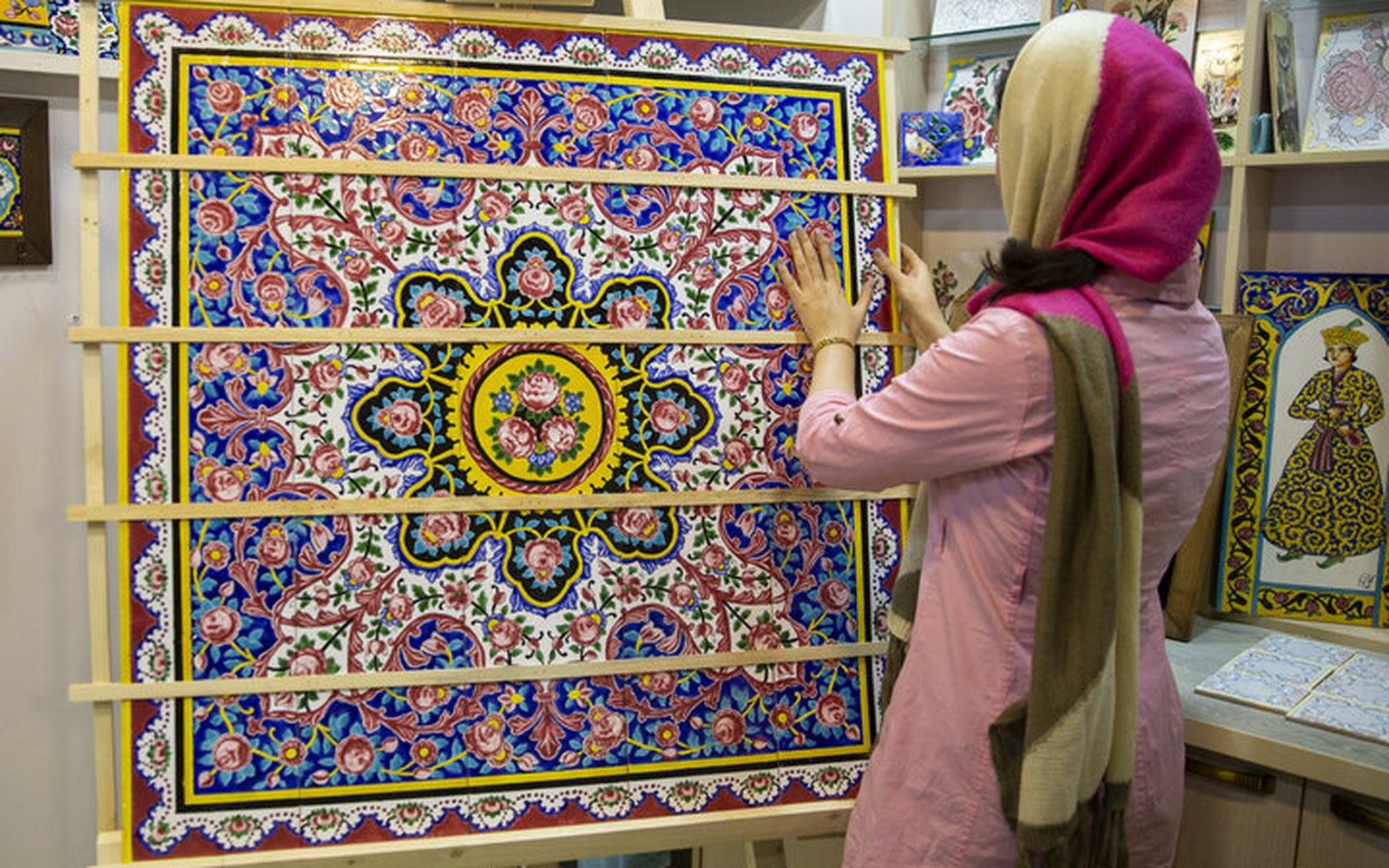
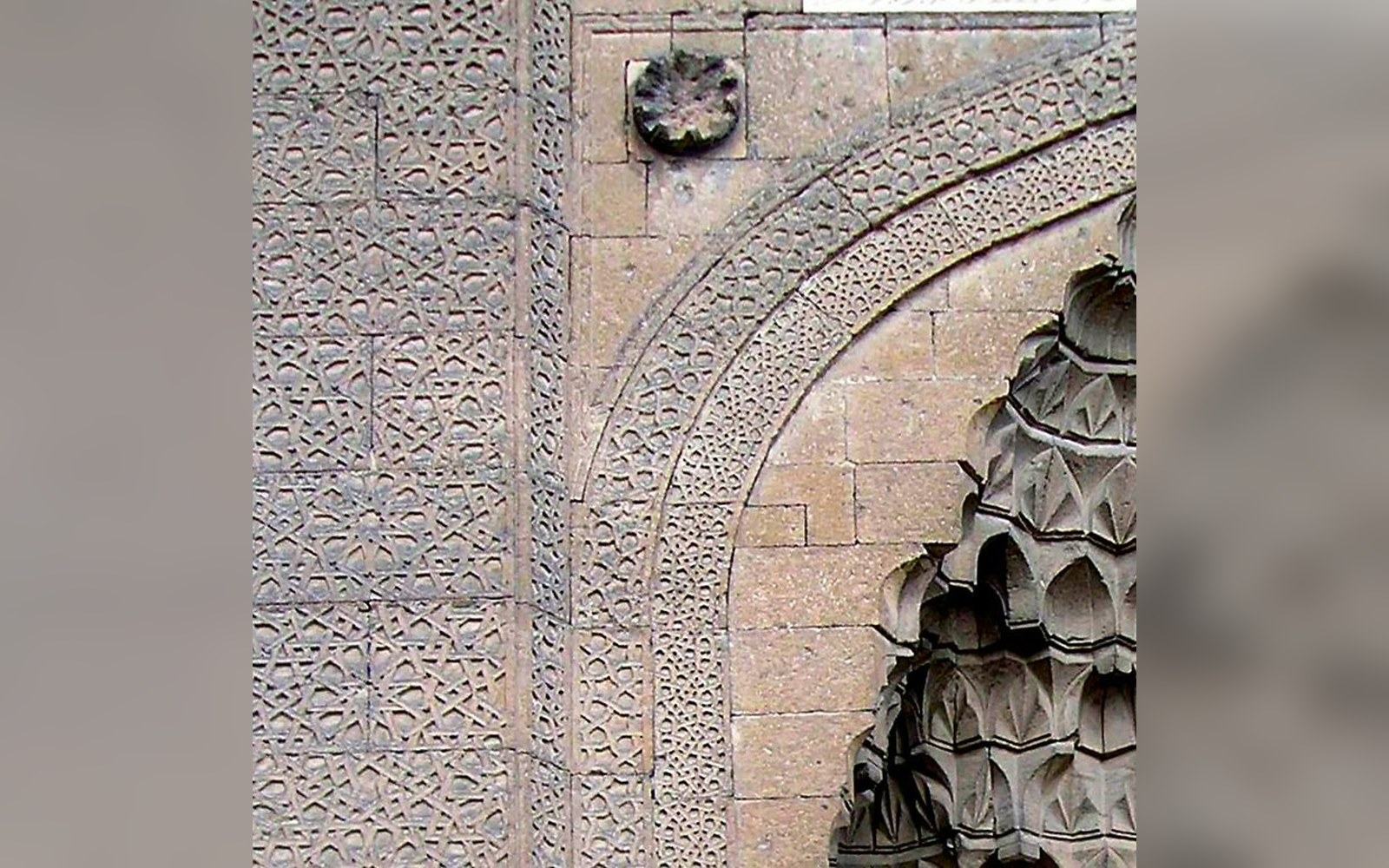
That separation is the whole point. Turquoise glaze on one tile, cobalt on another, white, black, buff, ochre each on their own. The kiln is simple; the complexity is entirely in the cutting and fitting. Each piece is shaped with a hammer and a hooked iron tool called a qalam, scoring and snapping the tile to the required profile. The cutter works from a cartoon — a full-scale drawing of the panel laid flat — and must read each fragment's position in the finished design before cutting it. A curve tightens the radius of error: a piece that is two millimetres too wide will push every adjacent piece out of line.
Assembly, face-down
The method of setting is counterintuitive. The cartoon is laid on a flat table, and the cut pieces are assembled face-down into it, building the design in reverse so that the installer can confirm each fit before the plaster locks it. When the panel section is complete, wet plaster — usually a lime-gypsum mix — is poured over the backs and left to cure. The hardened panel is then lifted, turned, and mounted on the wall or vault. What was the working surface becomes the face; the plaster seams between pieces are what show at the joints, typically less than two millimetres wide.
This inversion means the craftsman assembling the panel on the table never sees the design right-way-round until it is fixed in place. The skill is in reading the cartoon precisely and trusting the fit. Large vaulted surfaces — a deep iwan (vaulted portal), the interior of a dome — were executed in sections, each section's edges cut to interlock with the next. The geometry of the panel had to account for the curve of the surface it would wrap.
Why the form persists
Cut mosaic predates the 13th century in Central Asia and was already a refined practice by the Ilkhanid period. It reached its highest density of use in the Timurid 15th century, particularly in Samarkand and Herat, before spreading westward into Safavid Persia. At Isfahan's Friday Mosque and at the great Safavid complexes of the 17th century, moarrag work covers dados, portal spandrels, and minaret shafts — exactly the areas where crispness and close viewing matter most. The strapwork geometry it carries demands tight joints; a blurred edge on an interlace would collapse the illusion that the lines are continuous.
When the panel section is complete, wet plaster — usually a lime-gypsum mix — is poured over the backs and left to cure.
The painted panel eventually displaced it in high-volume work because a single kiln firing for a whole panel is dramatically faster than firing every colour separately and then cutting. But the painted panel cannot match the edge. Where the design is geometric and the viewing distance is close — a threshold, a dado, a niche at eye level — the cut method is simply better at what it does. The cost of labour is the cost of the boundary.