Garden · Entry 20
The Channel
The stream that moves through a Persian garden was designed to be heard before it was seen.

A line of controlled descent
The jūy — the garden channel — is not decoration pressed into the ground. It is a working conduit, typically narrow enough to step across and shallow enough to see the bottom clearly, moving water from its inlet at the garden's upper edge to a pool or reservoir below. The fall is deliberate and measured: enough gradient to keep the water moving and audible, not so much that it runs wastefully fast.

Lining is the first structural decision. Dressed stone or fired brick, set with lime mortar, gives the bed a surface smooth enough to lose minimal water to seepage yet rough enough to produce a faint, continuous sound — a low friction that translates the gradient into voice. An earthen channel would drink what it carried; a lined one delivers it.
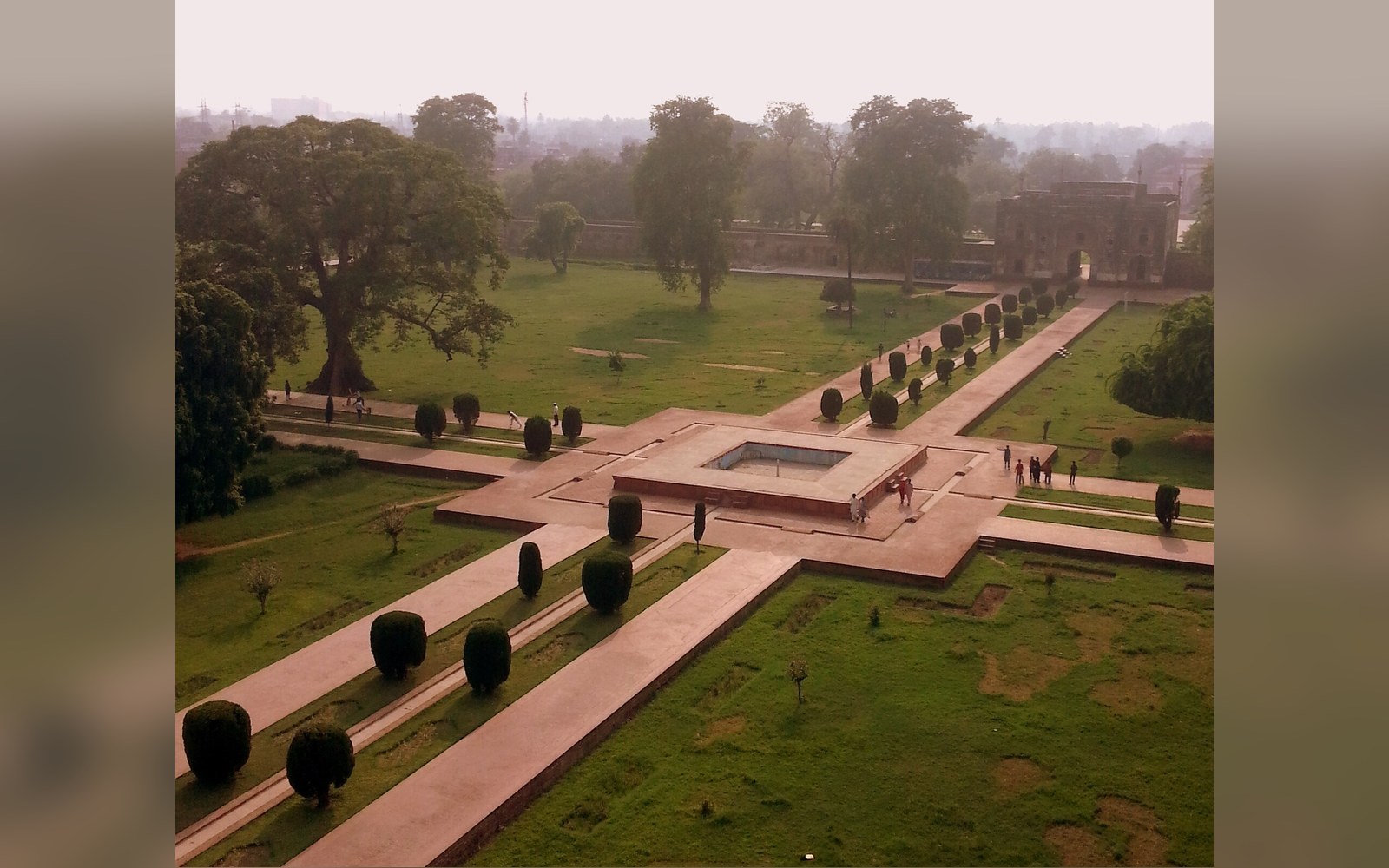
The plan follows the fourfold garden layout: two main channels crossing at the centre, quartering the enclosure. But the hydraulic thinking operates at a finer scale than the plan. Along each run, small drops are introduced — a step of a few centimetres, sometimes a carved stone lip, sometimes a brief widening that contracts again. Each drop breaks the laminar flow and reintroduces turbulence downstream. The water catches air; the sound rises. These drops are not placed at random. In gardens where the pavilion sits at the cross-axis or at the head of the long view, the drops concentrate in the reach closest to the sitting point, where the ear is.
Width matters too. The channel narrows through open planting and widens slightly beside hard paving or near a seating threshold, where the reflection matters and the sound should pool. The widened reach acts as a shallow mirror; the narrow run acts as an instrument.
Water enters from the garden's highest point, fed by a qanat or a diverted surface flow brought through the perimeter wall at a controlled aperture. From the inlet, gravity does the rest, and the gardener's skill lies entirely in reading the gradient and placing the interruptions. Nothing mechanical, nothing powered — only the relation between slope, liner, width and the deliberate obstruction of smooth flow.
The result is a garden that speaks at a low register whether or not anyone is moving through it. A seated person in the pavilion receives the sound as ambient, a continuous evidence of water in the heat, and that constancy was itself a form of comfort the design was built to supply.