Tile · Entry 13
Girih
Five polygons, a compass, a straightedge — and a surface that folds infinity into a wall.
The Tiles Beneath the Pattern
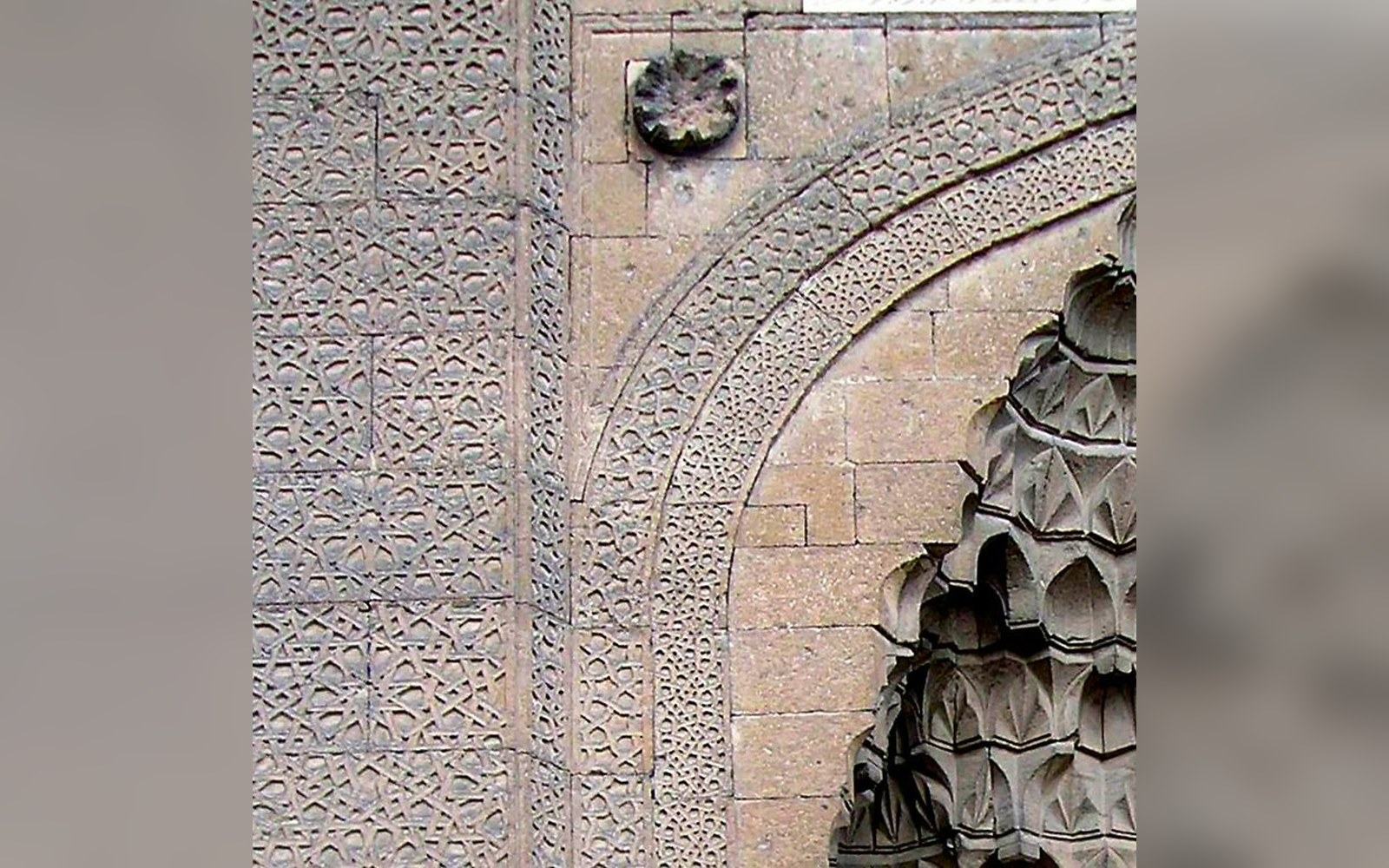
Girih — the word means "knot" in Persian — is not decoration applied to a surface. It is a geometry built into the surface, a structural logic that happens to be beautiful. The system works from a small family of interlocking polygons: the regular decagon, the elongated hexagon, the bowtie, the rhombus, and the regular pentagon. These five shapes tile a plane without gaps. Across each face, a network of strapwork lines is inscribed at fixed angles, and when the tiles are assembled, those lines flow continuously across every joint, producing the braided star-and-polygon field the eye reads as a single unbroken weave.
The geometry is constructed entirely with compass and straightedge. There is no grid, no Cartesian coordinate — only the relationships that fall from a circle, its radius, and the angles those tools can divide. The foundational move is the ten-fold division of a circle: from that single operation, every angle in the system follows. The strapwork lines on each tile run at multiples of 36 degrees, which is why they align so cleanly at borders, and why the pattern scales: halve the tile, the strapwork subdivides with it, generating a second-order pattern nested inside the first.
Why the Pattern Never Quite Closes
A grid of squares or equilateral triangles repeats exactly: translate the pattern by one unit and it lands on itself. Girih does not. The five-fold and ten-fold symmetry at the heart of the system is incompatible with the kind of strict periodicity that makes a tiled floor repeat step-for-step. The pattern has local symmetry — radiant stars, nested pentagons — without global periodicity. This means a girih field can extend without bound and never produce an identical section. In the 1970s and 1980s, mathematical physicists working on quasicrystals described structures with exactly this property. The tiling configurations found on the Darb-i Imam shrine in Isfahan, dating to 1453, exhibit what these later researchers identified as a Penrose-type quasi-periodic arrangement — produced, apparently, without that framework, by craftsmen navigating the geometry through its own internal rules.
A grid of squares or equilateral triangles repeats exactly: translate the pattern by one unit and it lands on itself.
Whether those craftsmen understood this in formal terms is a separate question. What they demonstrably understood was that the system permitted large-scale compositions without visible repetition: a wall could grow as long as materials allowed and the pattern would keep producing new arrangements. For an architecture of long façades and continuous surfaces, that is a practical virtue as much as a philosophical one.
Strapwork, Bisected
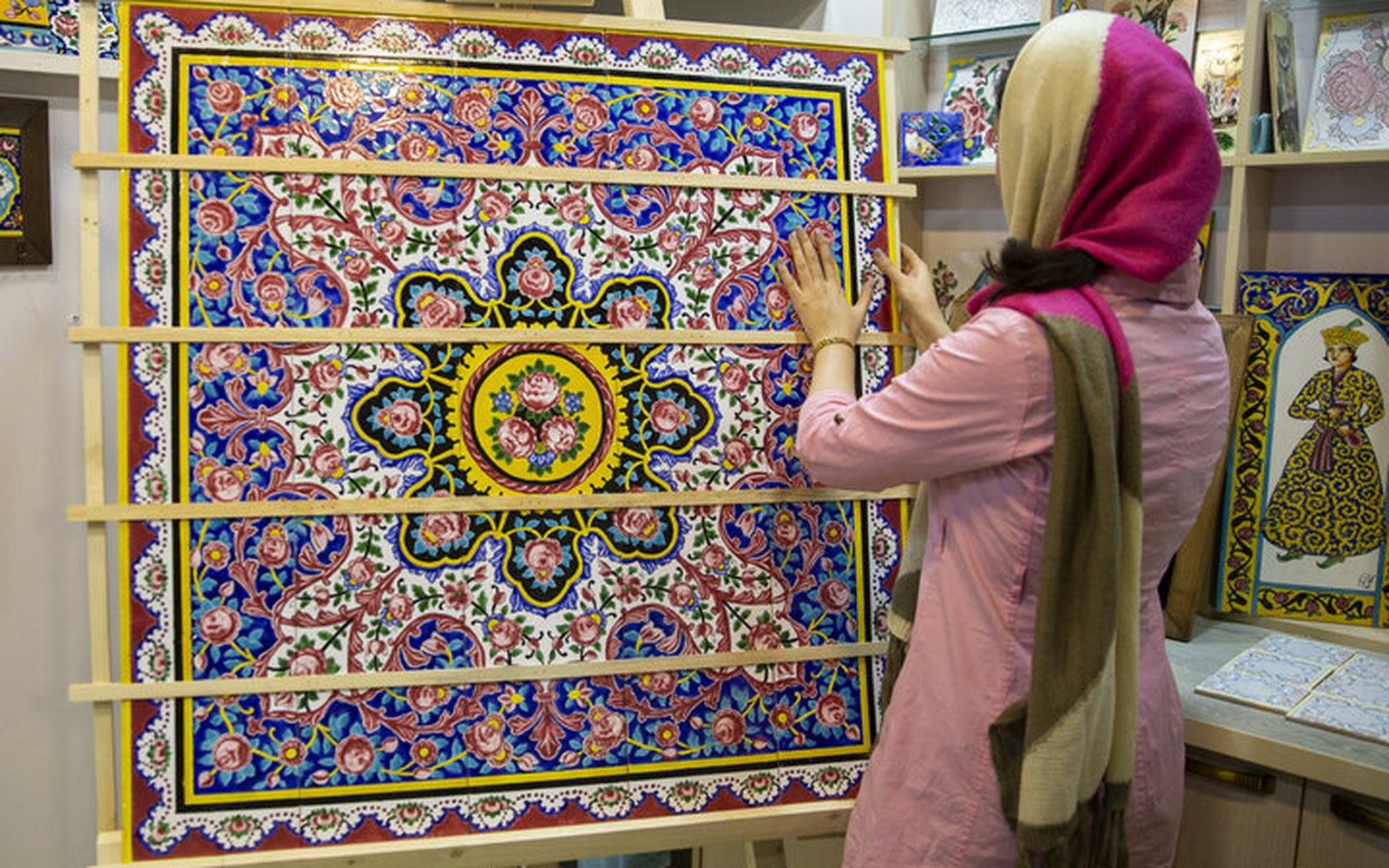
The strapwork lines — the ribbons that run across the tile faces and through every joint — have width as well as direction. That width is not fixed by the geometry alone; it is a design decision the craftsmen made in proportion to the tile size and the viewing distance. In tilework executed in the cut-mosaic technique, where each colour is fired separately and cut to shape, the strapwork could be rendered as a distinct colour running through the field, which sharpened the braided reading. In carved plaster and carved wood — the other two major surfaces where girih appears — the strapwork is a raised rib, and the depth of the carving controls the shadow that makes the geometry legible at distance.
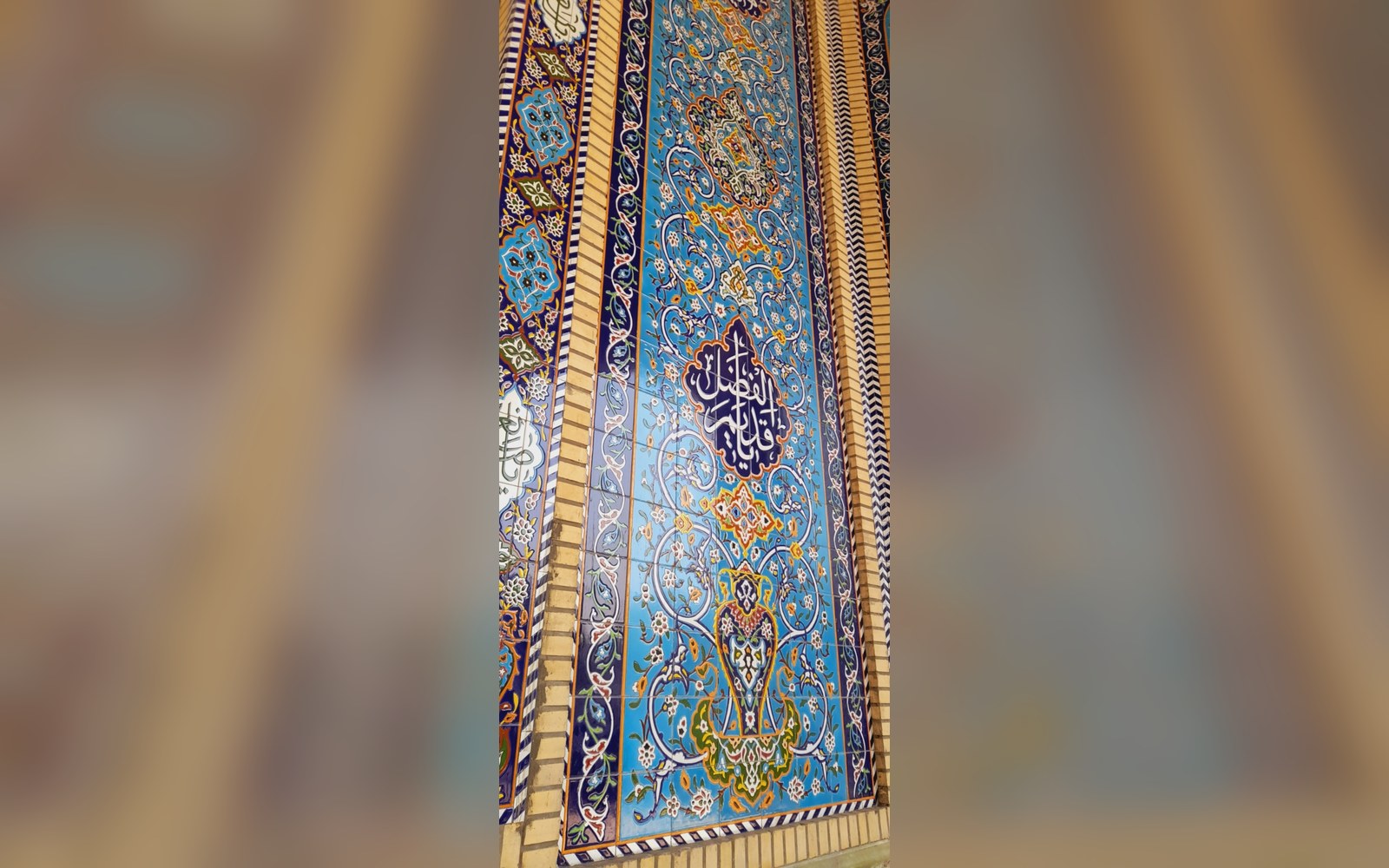
The Gonbad-e Qabous tower in Golestan predates the mature girih vocabulary, but by the Seljuk period, the system was fully articulated, and the Il-Khanid and Timurid workshops refined it into compositions of considerable scale and intricacy. The Friday Mosque in Isfahan carries girih in multiple media across centuries of addition and repair — a long record of the system being extended, nested and reinterpreted without being abandoned.
What the girih system gives a craftsman is a framework that makes error visible and correction local: a miscut tile disturbs the strapwork alignment at its edges, and the geometry itself identifies where the problem lies. The pattern is its own quality control. That is not an accidental property. A system built from a small set of precisely related figures, extended by rule rather than freehand, was always going to reward exactness and punish sloppiness — which is exactly what a craft tradition, taught hand to hand, needs.