Earth · Entry 22
The badgir
A tower that reads the wind as a pressure difference and uses it to push air through a building — even when the breeze is barely perceptible.
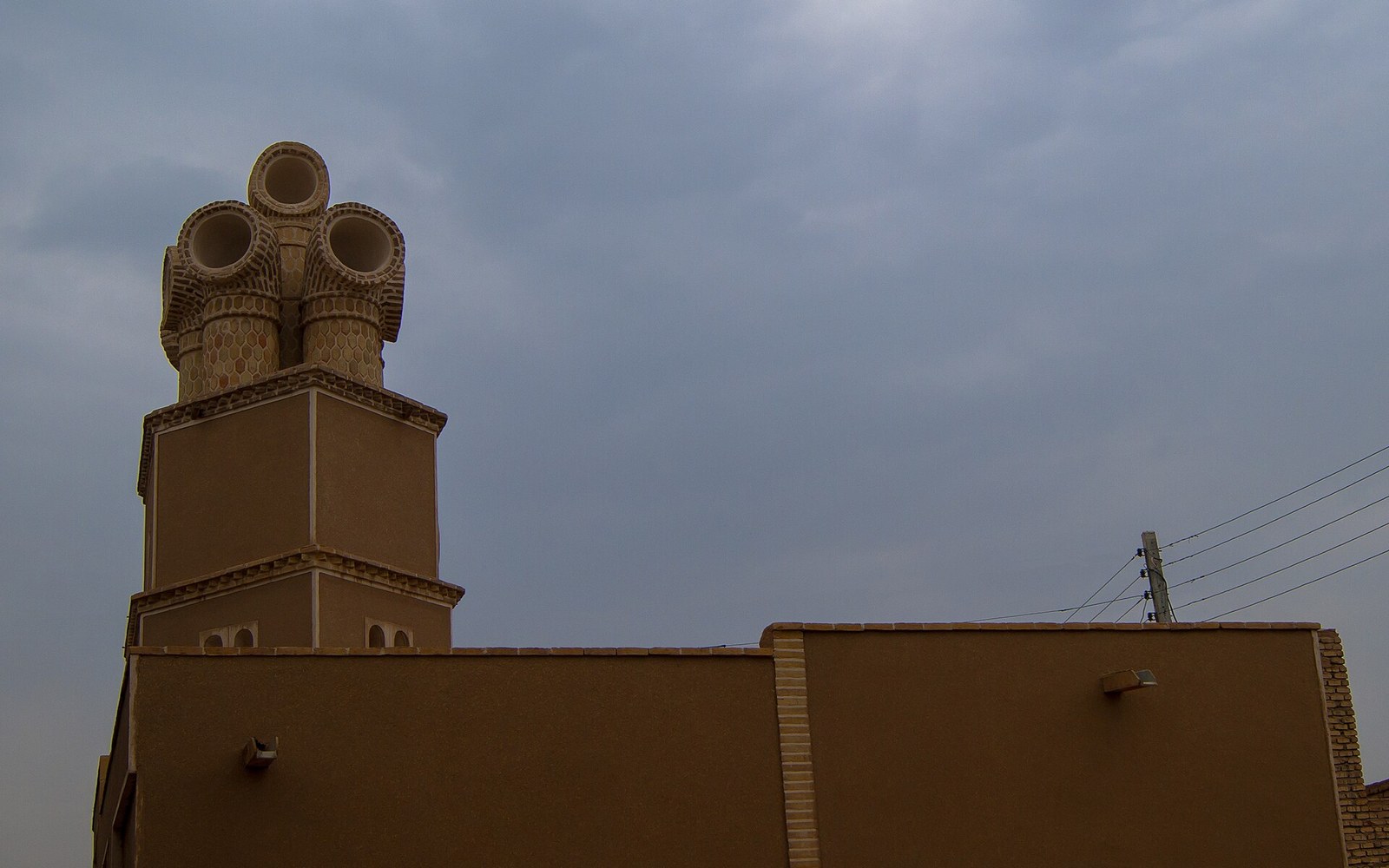
How a badgir moves air
The badgir — wind-catcher, literally "wind-taker" — is a rectangular tower projecting above the roofline, open on one or more faces, with internal partitions that channel air down into the rooms below. Its operation is hydraulic in all but the working fluid: pressure differences drive flow, and the tower is shaped to create them.
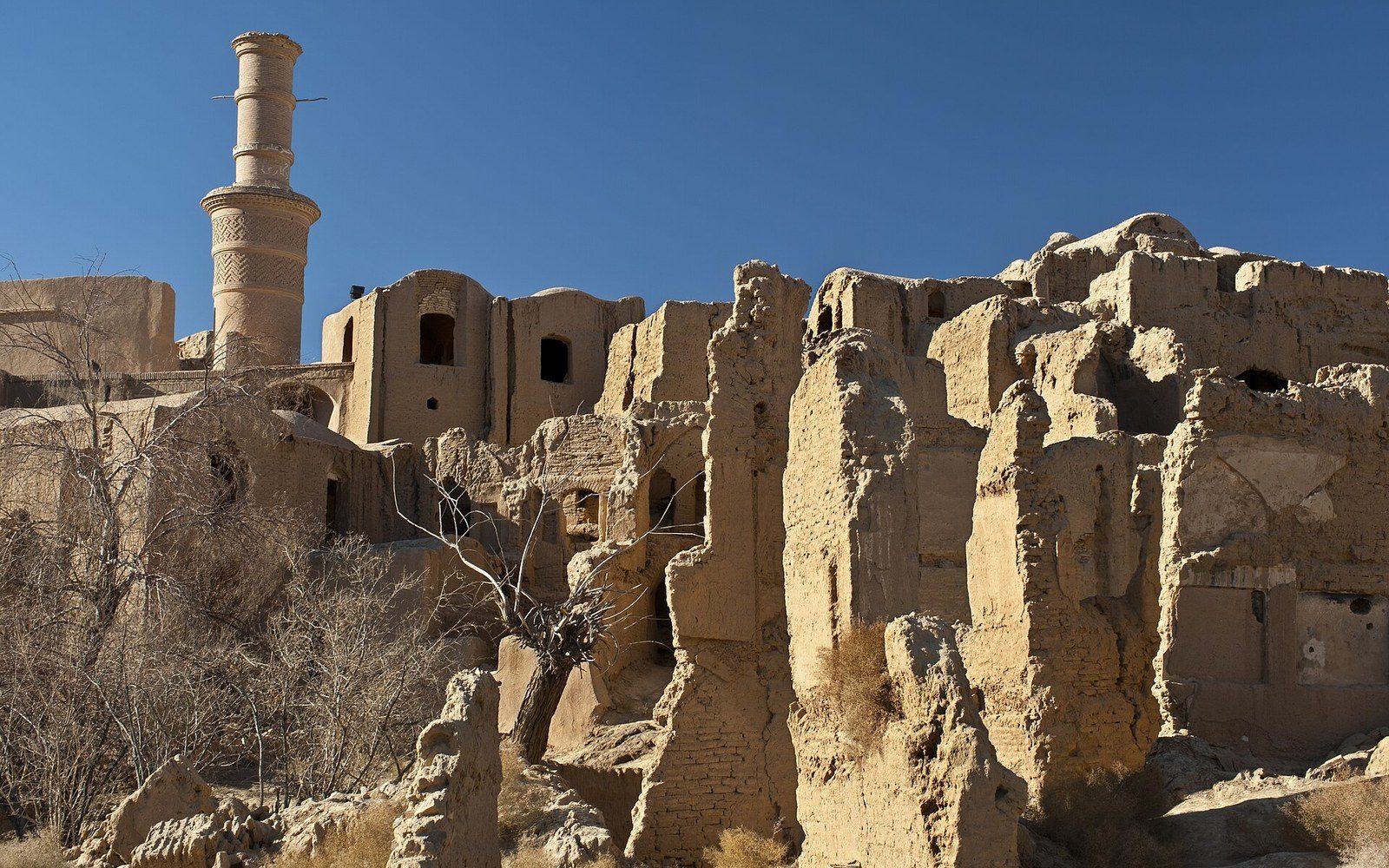
On the windward face, incoming air meets a vertical shaft and is pushed downward. On the leeward face, the same wind moving across the tower's top creates a zone of lower pressure — suction — that draws stale, warm air up and out. In a well-designed badgir, both effects operate simultaneously: cool air descends on one side while hot air is exhausted on the other. The partition between them keeps the two streams from short-circuiting at the top of the tower.
This is not simply ventilation by breeze. Even on a calm day, the temperature difference between the interior of a thick-walled building and the exterior air is enough to drive convective flow. Hot air rising inside the structure will pull cooler air down through the windward shaft if the geometry is correct. The badgir works passively in both a dynamic regime — wind — and a thermal one. It does not need both simultaneously.
The forms wind makes necessary
A single-faced badgir points toward the prevailing wind; this is the dominant form in regions where wind direction is consistent. Yazd, in the Iranian plateau's dry interior, is the canonical city of single-faced badgirs aligned to the bad-e hava, the seasonal north wind. Towers there rise five to eight metres above the roof, their open faces oriented precisely, their three closed faces flush-plastered to cut resistance.
Where wind direction varies, the four-faced tower answers: openings on all cardinal sides, each with its own descending shaft, so that whatever quarter the breeze comes from, at least one intake is active. A central partition or cruciform divider keeps incoming and outgoing streams separate regardless of which face is receiving. This form appears most often in larger houses and public buildings where a single orientation would be a gamble.
The geometry inside the shaft matters as much as what is above the roofline. A badgir set over a basement or an ab anbar — underground cistern — has a longer column of cool, dense air to draw on. The pressure head increases with depth: the taller the tower above, the deeper the space below, the stronger the draft. Height and depth are both levers on the same mechanism.
Material, wall and threshold
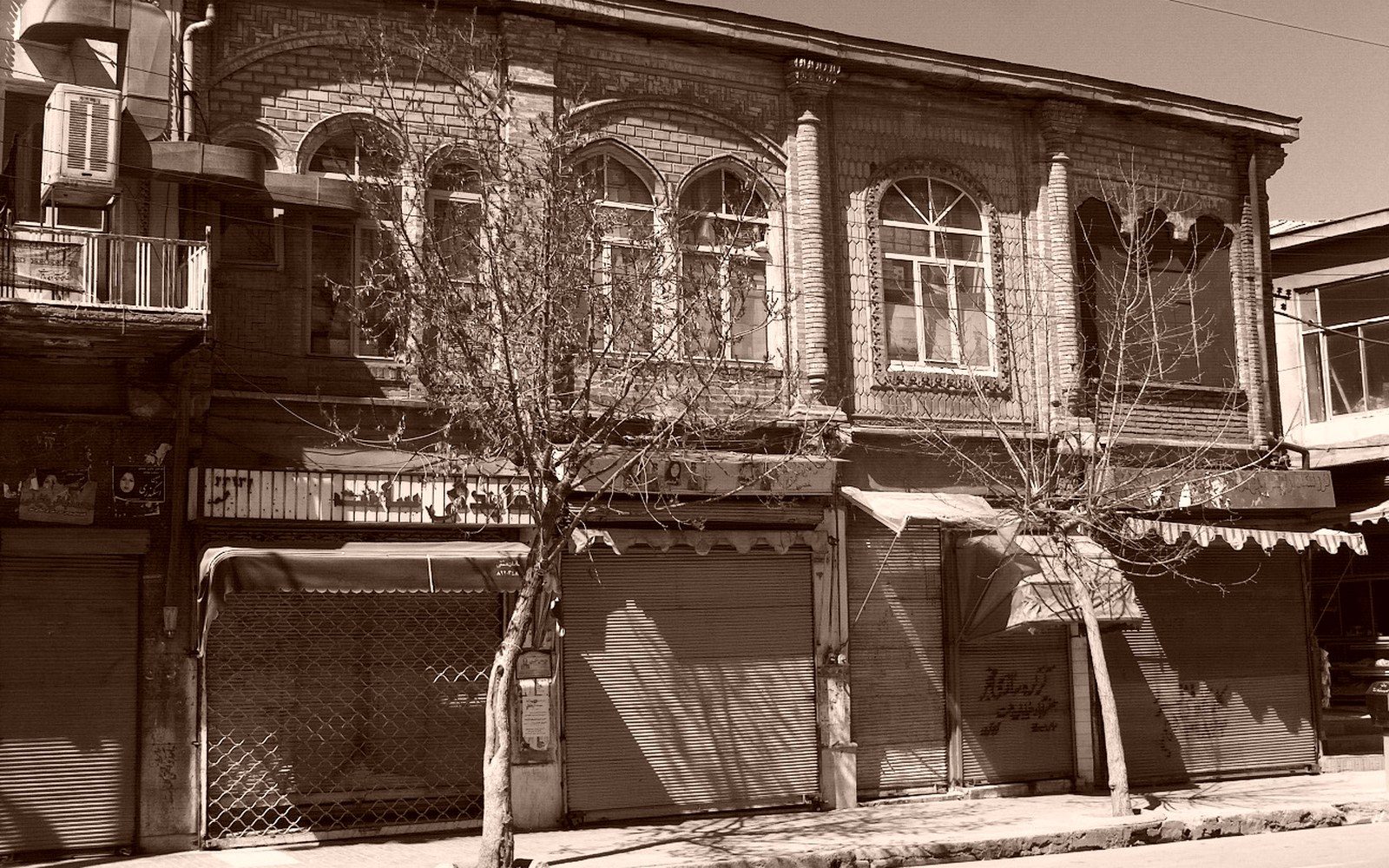
A badgir is built in the same material as the building beneath it: fired brick in urban construction, mud brick in vernacular work. The thick walls that insulate the rest of the structure carry through into the tower; the shaft interior stays cool because the surrounding mass does not transmit midday heat quickly. A thin-walled tower in metal or timber would heat the descending air before it reached the room — which is precisely what is not wanted.
At the base of the shaft, where it opens into the living space, the air may pass over a howz, a shallow pool, to pick up evaporative cooling before it reaches the occupants. This is not structural but behavioural — the homeowner's addition that takes the system from comfortable to cold. In Yazd and Kashan, where some of the finest surviving examples stand, the combination of badgir draft and howz evaporation can drop room temperature well below ambient even in the worst of summer.
Even on a calm day, the temperature difference between the interior of a thick-walled building and the exterior air is enough to drive convective flow.
The badgir is, in this sense, the building's respiratory apparatus: an intake-and-exhaust system whose performance is set by geometry at the design stage and then runs without maintenance, without moving parts, and without fuel. The wind does the work because the tower has been shaped to give it nowhere else to go.